
Beginning Sounds Worksheets PDF: A Comprehensive Guide
Beginning sounds worksheets PDF offer engaging phonics practice for early learners, fostering crucial reading and writing skills through
alphabet exploration and object recognition.
These worksheets enhance fine motor control alongside foundational literacy, providing free, printable consonant-focused activities for preschool and kindergarten students.
What are Beginning Sounds?
Beginning sounds represent the initial phoneme – the very first sound – in a spoken word. This foundational skill is a cornerstone of early literacy development, enabling children to decode and ultimately read words independently. Recognizing these initial sounds isn’t about knowing letter names initially; it’s about auditory awareness.
For example, in the word “cat,” the beginning sound is /k/. Worksheets focusing on beginning sounds help children connect these auditory perceptions with the corresponding letters, bridging the gap between spoken and written language. This connection is vital for phonemic awareness, a key predictor of reading success.
These worksheets often utilize pictures to visually represent words, making the learning process more accessible and engaging for young learners. Mastering beginning sounds sets the stage for blending sounds together to form complete words, a crucial step in the reading journey.
Why are Beginning Sounds Important for Early Learners?
Understanding beginning sounds is critically important as it forms the bedrock of phonological awareness, a key skill for reading and spelling success. Early identification of these sounds allows children to begin decoding words, moving beyond rote memorization towards independent reading.
Worksheets designed for this purpose actively promote this skill, fostering a deeper understanding of how sounds relate to letters. This knowledge directly impacts a child’s ability to blend sounds, segment words, and ultimately, become fluent readers and confident spellers.
Furthermore, mastering beginning sounds boosts a child’s confidence in their literacy abilities, encouraging a positive attitude towards learning. Early success with phonics builds a strong foundation for future academic achievement, setting them up for a lifelong love of reading and writing;
Benefits of Using Worksheets for Learning Beginning Sounds
Beginning sounds worksheets offer a multitude of benefits for young learners. They provide focused practice in a structured format, reinforcing the connection between letters and their corresponding sounds. This targeted approach accelerates phonics skill development, crucial for early literacy.
Worksheets also promote fine motor skill development through activities like coloring, tracing, and circling. The visual nature of these resources caters to different learning styles, making the learning process more engaging and accessible.
Moreover, worksheets are a cost-effective and convenient learning tool, easily printable and adaptable to individual student needs. They allow for independent practice, freeing up educators to provide personalized support. Consistent use builds confidence and solidifies understanding of foundational phonics concepts.

Types of Beginning Sounds Worksheets PDF
Diverse PDF worksheets exist, including picture matching, multiple-choice, fill-in-the-blank, and letter identification activities, catering to varied learning preferences and skill levels.
Worksheets with Picture Matching
Worksheets featuring picture matching are a cornerstone of early phonics instruction, providing a visually stimulating and intuitive way for young learners to grasp beginning sounds. These worksheets typically present a series of images – an apple, a ball, a cat – alongside a set of letters.
The child’s task is to identify the initial sound in each picture and then draw a line connecting it to the corresponding letter. This activity reinforces the link between graphemes (written letters) and phonemes (spoken sounds). The simplicity of this method makes it ideal for preschoolers and kindergarteners who are just beginning their phonics journey.
Effective picture matching worksheets utilize clear, colorful illustrations of familiar objects, minimizing ambiguity and maximizing engagement. Variations include matching pictures to the same beginning sound, or matching multiple pictures to a single letter representing their shared initial sound. These worksheets are often available as free PDF printables;
Worksheets with Multiple Choice Options
Beginning sounds worksheets utilizing multiple-choice formats offer a slightly more challenging, yet still accessible, approach to phonics practice. These worksheets present a picture and a question asking the student to identify the initial sound. Instead of generating the answer independently, children select from a provided set of options – typically three or four letters.
For example, a picture of a ‘dog’ might be accompanied by the question: “What sound does ‘dog’ start with?” followed by choices like ‘/d/’, ‘/b/’, ‘/f/’. This format encourages active listening and sound discrimination, requiring students to consciously analyze the beginning sound and compare it to the alternatives.
These worksheets are excellent for assessing comprehension and identifying areas where a child might need additional support; Many free PDF resources offer variations, including highlighting the correct answer or circling the letter representing the beginning sound.
Worksheets with Fill-in-the-Blank Activities
Beginning sounds worksheets featuring fill-in-the-blank exercises provide a more active and independent learning experience. These worksheets typically present a picture and a word with the initial consonant missing. The child’s task is to write the correct letter to complete the word, reinforcing the connection between sounds and letter representation.
For instance, a picture of a ‘sun’ might have the word “_un” presented, prompting the student to write the letter ‘s’ in the blank space. This activity demands a stronger understanding of letter-sound correspondence and encourages fine motor skill development through handwriting practice.
These worksheets are often differentiated to cater to varying skill levels, with some offering a word bank for support, while others require complete recall. Numerous free PDF resources provide these engaging activities, promoting phonemic awareness and early literacy skills.
Worksheets with Letter Identification
Beginning sounds worksheets focused on letter identification directly assess a child’s ability to recognize letters and associate them with their corresponding sounds. These worksheets often present a series of letters, and students are asked to circle or highlight the letter that represents the beginning sound of a given word or picture.

For example, a worksheet might display the letters ‘b’, ‘p’, and ‘d’, alongside a picture of a ‘ball’. The child would then identify and circle the letter ‘b’ as the correct answer. This type of activity strengthens phonemic awareness and letter recognition skills simultaneously.
Many free PDF resources offer variations of this exercise, including matching letters to pictures or identifying the initial letter in a list of words. These worksheets are foundational for building a strong literacy base.

Creating Effective Beginning Sounds Worksheets
Designing impactful beginning sounds worksheets requires careful image selection, recognizable words, clear instructions, and appropriate font sizes for optimal learning.
Choosing Appropriate Images
Selecting visuals for beginning sounds worksheets is paramount to engagement and comprehension. Images should be highly recognizable to young children, representing concrete objects they encounter daily. Avoid abstract concepts or overly complex illustrations that might cause confusion. Prioritize clarity and simplicity; a clear depiction of an apple, for example, is far more effective than a stylized or artistic rendering.
Consider the diversity of images to represent a wide range of sounds and avoid reinforcing stereotypes. Ensure images are age-appropriate and culturally sensitive. High-quality images are also crucial – blurry or pixelated pictures detract from the learning experience. The chosen images should directly correlate with the target sound, providing a strong visual cue for students to make the connection between the letter and its corresponding sound.
Selecting Common and Recognizable Words
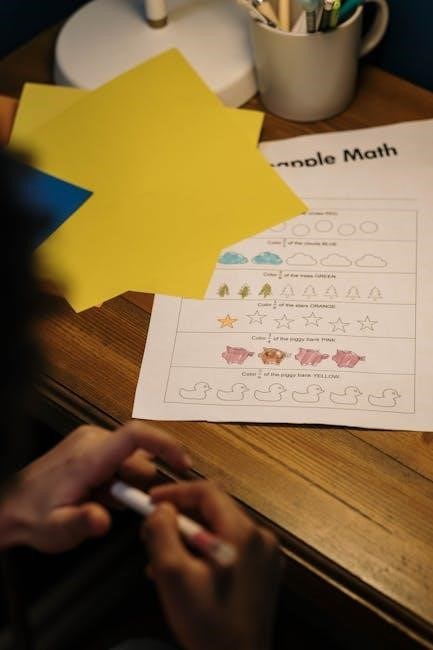
When crafting beginning sounds worksheets, prioritize words that are frequently encountered in a child’s everyday vocabulary. Familiarity breeds success; students are more likely to accurately identify the initial sound of a word they already know. Opt for simple, one-syllable words whenever possible, as these are easier for young learners to decode. Examples include “cat,” “dog,” “sun,” and “ball.”
Avoid obscure or uncommon words that may hinder comprehension and discourage participation. The goal is to reinforce phonemic awareness, not to test vocabulary. Carefully consider the developmental stage of the learners; words should align with their existing linguistic knowledge. A balance between frequently used words and slightly challenging ones can promote growth, but always prioritize recognizability.
Using Clear and Simple Instructions
Beginning sounds worksheets are most effective when accompanied by concise, easily understood instructions. Avoid complex phrasing or multi-step directions that can overwhelm young learners. Use action verbs like “circle,” “match,” or “write” followed by a clear description of the task. For example, “Circle the picture that begins with the letter ‘b’.”
Employ visual cues alongside written instructions to cater to different learning styles. Consider including an example to demonstrate the expected response. Break down complex tasks into smaller, manageable steps. Ensure the language used is age-appropriate and avoids jargon. Clarity minimizes frustration and maximizes engagement, allowing students to focus on the phonics skill itself.
Font Size and Readability Considerations
When designing beginning sounds worksheets PDFs, prioritize readability for young eyes. Utilize a large, clear font size – typically 24-28 points – to ensure letters are easily distinguishable. Opt for simple, sans-serif fonts like Arial or Comic Sans, as these are generally more accessible for early readers.
Sufficient spacing between letters, words, and lines is crucial to prevent visual crowding. Avoid using overly decorative or stylized fonts that can hinder letter recognition. Ensure adequate contrast between the text color and background; black text on a white background is often the most effective. Consider the overall layout, avoiding cluttered designs. A clean, uncluttered worksheet promotes focus and reduces cognitive load, supporting successful learning.
Free Printable Beginning Sounds Worksheets PDF Resources
Numerous websites provide free beginning sounds worksheets PDFs, offering convenient access to valuable phonics practice for educators and parents alike.
Popular Websites Offering Free Worksheets
Several online platforms are dedicated to providing educators and parents with free, printable beginning sounds worksheets PDF resources. Education.com stands out as a comprehensive source, offering a vast library of phonics worksheets tailored for preschool and kindergarten students, categorized by skill level and theme. Their collection includes picture matching, letter identification, and fill-in-the-blank activities.
Twinkl is another popular choice, known for its beautifully designed and engaging educational materials. They offer a range of beginning sounds worksheets, often incorporating colorful illustrations and playful themes to capture children’s attention. K5 Learning provides a more structured approach, with worksheets aligned to specific learning objectives and skill development.
AllKidsNetwork also features a selection of free worksheets, focusing on foundational phonics skills. These websites generally require a free account registration to access the full range of downloadable resources, but the benefits of readily available, high-quality materials make it a worthwhile investment of time;
Specific Worksheet Packs Available for Download
Numerous themed beginning sounds worksheets PDF packs are readily available for download, catering to diverse learning preferences. A common pack focuses on individual letter sounds, presenting a series of images for each letter where children identify the initial sound. Another popular option is the “Animal Beginning Sounds” pack, featuring pictures of various animals, prompting students to match the animal to its starting sound.
Seasonal packs, such as “Fall Beginning Sounds” or “Winter Beginning Sounds,” incorporate relevant imagery to enhance engagement. More comprehensive packs combine multiple skills, including letter tracing, picture matching, and simple word writing. Some resources offer differentiated worksheets, providing varying levels of difficulty to accommodate diverse learners.
Look for packs that include answer keys for easy assessment and progress monitoring. Many websites bundle worksheets into larger phonics packs, covering a broader range of early literacy skills alongside beginning sounds practice.
Copyright and Usage Rights of Free Resources
When utilizing free beginning sounds worksheets PDF resources, understanding copyright and usage rights is crucial. Most free worksheets are offered for personal or classroom use only. Commercial reproduction, distribution, or alteration is generally prohibited without explicit permission from the copyright holder.
Many websites clearly state their terms of use, outlining permitted activities; Some allow educators to share worksheets with their students but restrict uploading them to publicly accessible platforms. Always check the specific license agreement associated with each resource before use.
Attribution may be required; some creators request acknowledgment of their work. Respecting copyright protects the creators’ intellectual property and ensures continued availability of free educational materials. Ignoring these rights can lead to legal consequences. Prioritize resources with clearly defined usage policies;

Integrating Worksheets with Other Learning Activities
Beginning sounds worksheets PDF become more impactful when combined with phonics lessons, engaging games, and connecting sounds to everyday objects.
Using Worksheets as Part of a Phonics Lesson
Beginning sounds worksheets PDF seamlessly integrate into a comprehensive phonics lesson, acting as a valuable reinforcement tool after initial sound instruction. Begin by explicitly teaching a target sound, such as /b/, using multi-sensory methods like songs or actions.
Then, introduce a worksheet where students identify pictures that begin with that sound, circling or coloring them. This provides immediate practice and assessment. Extend the lesson by having students brainstorm additional words starting with the same sound, fostering vocabulary development.
These worksheets aren’t isolated activities; they’re a component of a larger phonics sequence. Follow up with blending exercises, where students combine the target sound with other sounds to form simple words. Regularly incorporating these worksheets solidifies sound-letter correspondence and builds a strong foundation for reading.
Incorporating Games and Songs
Transform learning beginning sounds with engaging games and songs! Pair beginning sounds worksheets PDF with activities like “I Spy” – “I spy with my little eye, something that begins with /m/!” – to make practice interactive and fun.
Create a “Sound Sort” game where students categorize pictures from their worksheets based on their initial sounds. Musical reinforcement is also powerful; sing alphabet songs emphasizing the sounds, or create original tunes focusing on specific letter-sound connections.
These playful approaches reduce learning anxiety and boost retention. Games and songs cater to different learning styles, making phonics accessible to all students. Remember to connect the fun back to the worksheet, reinforcing the link between auditory, kinesthetic, and visual learning.
Connecting Worksheets to Real-World Objects
Bridge the gap between beginning sounds worksheets PDF and everyday life! Extend learning beyond the page by having students identify objects in the classroom or at home that correspond to the sounds they’re practicing. For example, if the worksheet focuses on /b/, ask them to find a ball, book, or block.
Bring in a “sound box” filled with real objects – a toy car, a crayon, a banana – and have students sort them based on their initial sounds. This tactile experience solidifies understanding. Encourage students to share objects from home, creating a collaborative learning environment.
This connection demonstrates the practical application of phonics, making it more meaningful and memorable. It reinforces that letters and sounds aren’t abstract concepts, but tools for decoding the world around them.
Advanced Beginning Sounds Concepts
Worksheets can introduce consonant blends like ‘bl’ and ‘st’, digraphs such as ‘sh’ and ‘ch’, and help differentiate tricky sounds like ‘b’ versus ‘p’.
Consonant Blends (e.g., bl, st, tr)
Worksheets focusing on consonant blends present a slightly more complex phonics challenge for emerging readers, building upon the foundational understanding of single beginning sounds. These blends – combinations like ‘bl’, ‘st’, ‘tr’, ‘fr’, and ‘gr’ – require children to identify two consonants working together to create a distinct sound at the start of a word.
Effective worksheets for consonant blends often feature pictures representing words containing these blends (e.g;, a block for ‘bl’, a star for ‘st’). Activities might involve circling words beginning with a specific blend, matching pictures to the correct blend, or completing words by adding the missing blend.
Gradual introduction is key; start with commonly used blends and provide ample practice. Some worksheets incorporate a playful element, such as a maze where children follow a path of words with the target blend. Remember to emphasize the blended sound, not just the individual consonants, to solidify understanding.
Digraphs (e.g., sh, ch, th)
Beginning sounds worksheets incorporating digraphs – letter combinations like ‘sh’, ‘ch’, ‘th’, ‘wh’, and ‘ph’ that create a single, unique sound – represent a further step in phonics development. Unlike blends, digraphs don’t simply combine sounds; they create a new one. This can be tricky for young learners, requiring focused practice and clear instruction.
Effective worksheets for digraphs utilize visual aids, pairing pictures with words that feature the target digraph (e.g., a ship for ‘sh’, a chair for ‘ch’). Activities can include identifying the digraph sound, circling pictures that begin with the digraph, or filling in missing digraphs to complete words.
It’s helpful to contrast digraphs with similar sounds to avoid confusion. For instance, explicitly compare ‘sh’ and ‘s’ sounds. Repetition and multi-sensory approaches, like saying the sound while tracing the letters, can reinforce learning.
Differentiating Between Similar Sounds (e.g., b/p, d/t)
Beginning sounds worksheets often address the challenge of distinguishing between sounds produced similarly, such as /b/ and /p/, or /d/ and /t/. These minimal pairs differ by a single phonetic feature – voicing or place of articulation – which can be subtle for developing ears. Targeted practice is crucial for mastery.
Effective worksheets present these sounds in direct contrast. Activities might involve sorting pictures based on the initial sound, identifying the odd one out, or completing sentences with the correct sound. Visual cues, like emphasizing the mouth’s position for each sound, can be beneficial.
Multi-sensory techniques, such as feeling the vibration when producing voiced sounds (/b/, /d/), can aid differentiation. Explicitly pointing out the differences – “/b/ is made with your lips, /p/ with air” – reinforces understanding.

Tips for Parents and Educators
Beginning sounds worksheets thrive with fun, positive reinforcement, and adaptation to each child’s pace; consistent assessment tracks their progress effectively.
Making Learning Fun and Engaging
Transforming beginning sounds practice into an enjoyable experience is paramount for young learners. Worksheets shouldn’t feel like a chore, but rather an exciting exploration of sounds and letters! Incorporate colorful designs and relatable images – pictures of animals, toys, or everyday objects instantly capture a child’s attention.
Turn the activity into a game! Challenge your child to “hunt” for objects around the room that start with a specific sound. Use playful voices and silly rhymes to reinforce the connection between letters and their corresponding sounds. Consider creating a reward system, like a sticker chart, to celebrate milestones and encourage continued effort.
Remember, short, focused sessions are more effective than lengthy ones. Keep the energy high and the learning lighthearted. A positive attitude from both parent and educator is contagious, fostering a love of learning that will extend far beyond the worksheet itself.
Providing Positive Reinforcement
Positive reinforcement is a cornerstone of successful early literacy development when utilizing beginning sounds worksheets PDF. Instead of focusing on errors, celebrate effort and progress. A simple “Great try!” or “I see you’re really thinking about the sounds!” can build confidence.
Specific praise is far more effective than generic statements. Instead of saying “Good job,” try “I noticed how carefully you listened to the beginning sound in ‘sun’ – excellent work!” Sticker charts, small rewards, or even enthusiastic high-fives can motivate children to continue practicing.
Create a supportive and encouraging environment where mistakes are seen as opportunities for learning. Emphasize that learning takes time and that every step forward, no matter how small, deserves recognition. A child who feels valued and supported is more likely to embrace the challenge and persevere.
Adapting Worksheets to Individual Needs
Effective use of beginning sounds worksheets PDF requires tailoring activities to each child’s unique learning pace and style. For students struggling with sound identification, begin with fewer options per worksheet, focusing on clearly distinct sounds. Highlight the initial sound within the word as a visual cue.
Conversely, for advanced learners, increase the complexity by including worksheets with more choices or introducing consonant blends and digraphs earlier. Allow them to create their own worksheets, drawing pictures and identifying the beginning sounds independently.
Consider a child’s interests when selecting images for the worksheets. If a child loves dinosaurs, incorporate dinosaur-themed activities. Modifying the worksheets ensures engagement and maximizes learning potential, fostering a positive attitude towards phonics.
Assessing Student Progress
Regularly evaluating a child’s performance with beginning sounds worksheets PDF is crucial for monitoring their phonological awareness development. Observe which sounds consistently pose challenges and which are readily identified. Track accuracy rates over time to identify areas of improvement.
Beyond simply marking answers correct or incorrect, note how a child arrives at their answer. Are they relying on memorization or genuinely understanding the sound-letter relationship? Use observation to inform future instruction.
Consider incorporating informal assessments alongside the worksheets, such as asking the child to identify beginning sounds in spoken words or to generate words starting with a specific sound. This holistic approach provides a comprehensive understanding of their progress and guides further learning.